Best Privacy-Focused Analytics Tools
Privacy-focused analytics tools let you track website performance without compromising visitor data. These platforms offer an alternative to Google Analytics for organizations that prioritize data protection, regulatory compliance, or simply want to give users more control over their information.
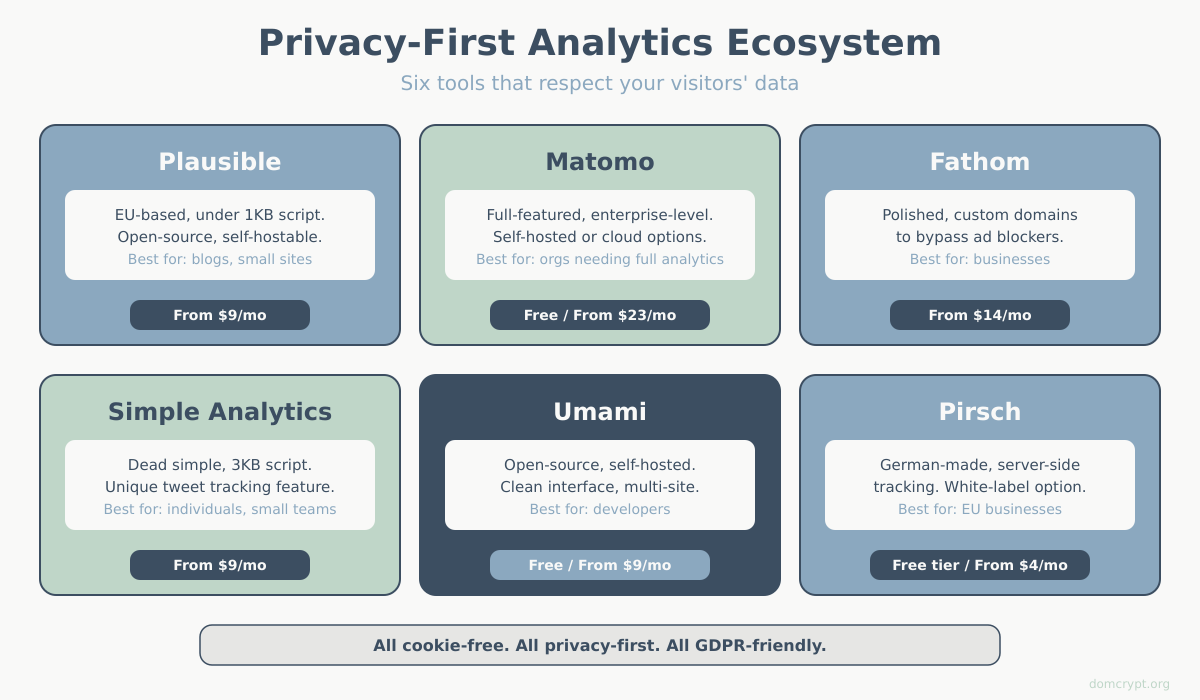
Why Choose Privacy-First Analytics?
Traditional analytics platforms collect extensive data about visitors — often more than necessary for understanding website performance. Privacy-focused alternatives take a different approach:
- Minimal data collection: Only gather what’s needed for actionable insights
- No personal data: Avoid tracking individual users across sessions
- Cookie-free options: Many work without cookies, reducing consent requirements
- GDPR/CCPA compliance: Built from the ground up for privacy regulations
- Data ownership: Your analytics data stays under your control
If you’re unfamiliar with web analytics fundamentals, start there to understand what metrics matter before choosing a tool.
Top Privacy-Focused Analytics Tools
1. Plausible Analytics
Plausible is a lightweight, open-source analytics tool built in the EU. Its script is under 1KB — about 45 times smaller than Google Analytics.
Key Features:
- No cookies required (GDPR-compliant without consent banners)
- Simple dashboard — no learning curve
- Open-source with self-hosting option
- Goal tracking and custom events
- UTM campaign tracking
- Email reports
Pricing: From $9/month (10K pageviews) to custom plans for high traffic. Self-hosted version is free.
Best for: Blogs, small businesses, developers who want simple metrics without complexity or privacy concerns.
2. Matomo
The most feature-rich privacy-first option. Matomo offers enterprise-level analytics while keeping data under your control.
Key Features:
- Full-featured analytics comparable to GA4
- Session recordings and heatmaps
- 100% data ownership
- Self-hosted or cloud options
- No data sampling
- Import Google Analytics history
Pricing: Self-hosted is free. Cloud starts at $23/month.
Best for: Organizations needing comprehensive analytics with full privacy compliance. See our complete Matomo guide for setup details.
3. Fathom Analytics
Fathom balances simplicity with useful features. It’s a commercial product focused on “privacy-first” analytics for businesses.
Key Features:
- Cookie-free tracking
- EU isolation option for data storage
- Custom domains to bypass ad blockers
- API access for integrations
- Event tracking and goals
- Uptime monitoring included
Pricing: From $14/month (100K pageviews). No free tier, but 7-day trial available.
Best for: Businesses wanting a polished, reliable analytics product with strong privacy credentials.
4. Simple Analytics
A straightforward tool that does exactly what the name suggests — simple, privacy-focused tracking.
Key Features:
- No cookies, no tracking scripts that follow users
- Lightweight script (3KB)
- Real-time dashboard
- Event tracking
- Tweet tracking (unique feature)
- Data export
Pricing: From $9/month (100K pageviews). 14-day free trial.
Best for: Individuals and small teams who want dead-simple analytics without the complexity.
5. Umami
An open-source, self-hosted analytics tool with a clean interface and solid feature set.
Key Features:
- Free and open-source
- Self-hosted only (you control the data)
- Cookie-free by default
- Real-time data
- Custom events
- Multiple websites from one installation
Pricing: Free (self-hosted). Cloud hosting starts at $9/month.
Best for: Developers and technical teams comfortable with self-hosting who want a free solution.
6. Pirsch
German-made analytics with a focus on simplicity and GDPR compliance.
Key Features:
- Cookie-free tracking
- Server-side tracking option
- White-label for agencies
- Custom event tracking
- Conversion goals
- Data stored in Germany
Pricing: Free tier (10K pageviews/month). Paid from $4/month.
Best for: European businesses prioritizing GDPR compliance with budget-friendly options.
Privacy Analytics Tools Comparison
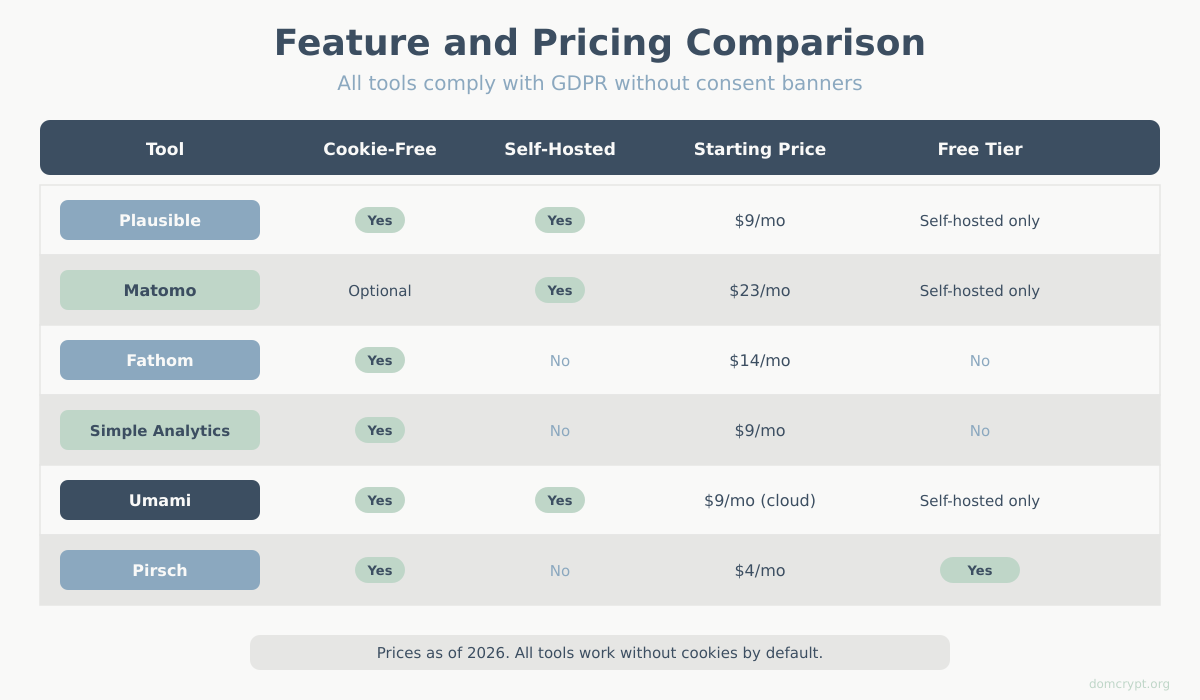
| Tool | Cookie-Free | Self-Hosted | Starting Price | Free Tier |
|---|---|---|---|---|
| Plausible | Yes | Yes | $9/month | Self-hosted only |
| Matomo | Optional | Yes | $23/month | Self-hosted only |
| Fathom | Yes | No | $14/month | No |
| Simple Analytics | Yes | No | $9/month | No |
| Umami | Yes | Yes | $9/month (cloud) | Self-hosted only |
| Pirsch | Yes | No | $4/month | Yes (10K views) |
How to Choose the Right Privacy Analytics Tool
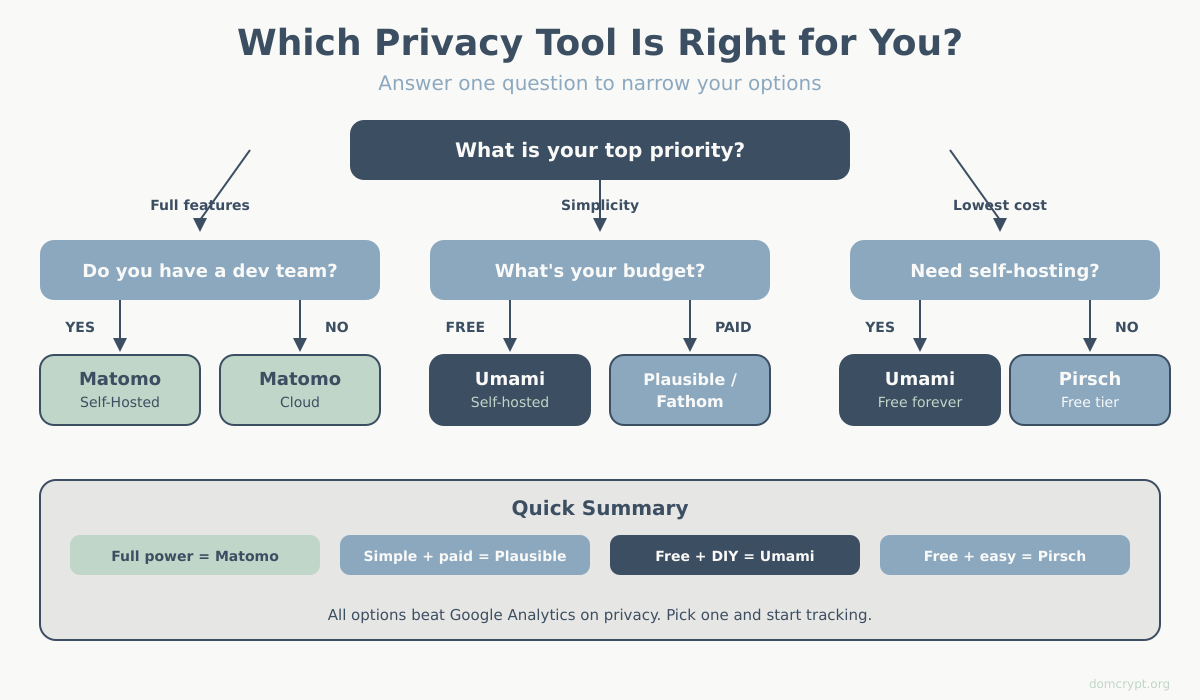
Ask yourself these questions:
What’s your technical comfort level?
- Non-technical: Fathom, Simple Analytics, or Plausible cloud
- Somewhat technical: Any cloud option works
- Developer/DevOps: Self-hosted Umami, Matomo, or Plausible
What features do you need?
- Basic pageviews and traffic sources: Any tool works
- Event tracking and goals: All tools support this
- Heatmaps and session recordings: Only Matomo
- E-commerce tracking: Matomo is strongest here
What’s your budget?
- Free: Self-hosted Umami, Matomo, or Plausible
- Under $10/month: Pirsch, Plausible, Simple Analytics, Umami cloud
- Under $25/month: Add Fathom and Matomo cloud
- Enterprise needs: Matomo enterprise or Fathom with custom plans
Where must data be stored?
- EU only: Plausible, Fathom (EU option), Pirsch, Matomo
- Your own servers: Self-hosted options (Matomo, Plausible, Umami)
- Flexible: Most tools offer location options
For detailed guidance on platform selection, see our analytics platform comparison guide.
Migration from Google Analytics
Switching from GA to a privacy-first tool is straightforward:
- Install new tracking code alongside GA (run both temporarily — if you’re using Google Tag Manager, adding a second analytics snippet takes minutes)
- Verify data collection for a week or two
- Export important GA data (Matomo can import GA history)
- Remove GA tracking code
- Update your privacy policy
Most privacy tools don’t require consent banners in the EU, so you may be able to remove cookie popups after migration.
Privacy Analytics and GDPR
Most privacy-first analytics tools claim GDPR compliance without consent. Here’s why:
- They don’t use cookies (so cookie consent doesn’t apply)
- They don’t collect personal data (so GDPR data subject rights are simplified)
- They don’t share data with third parties
- Data minimization is built into the design
However, consult with legal counsel for your specific situation. Some organizations still require consent for any analytics tracking.
Limitations of Privacy-First Analytics
These tools trade some capabilities for privacy:
- Different engagement signals: Most privacy tools still report a bounce rate; GA4 replaced it with engagement rate, which behaves differently — worth understanding if you’re comparing numbers across platforms
- No cross-device tracking: Can’t identify the same user on phone and desktop
- No remarketing: Can’t build audiences for ad targeting
- Limited integrations: Fewer connections to marketing tools
- Basic attribution: Most offer simple last-click only
- No demographic data: Age, gender, interests unavailable
For most websites, these limitations don’t matter. If you need these features, compare with Google Analytics 4 or check our GA4 vs Matomo comparison.
Summary
Privacy-first analytics tools have matured significantly. You no longer need to sacrifice insights for privacy — tools like Plausible, Matomo, and Fathom provide the metrics most websites need while respecting user privacy.
For simple tracking, Plausible or Fathom work well. For enterprise needs with session recordings and e-commerce, Matomo is the most complete option. For developers who want free and flexible, self-hosted Umami or Plausible are excellent choices.
The right tool depends on your budget, technical skills, and specific requirements. Start with a trial or free tier to test before committing.